
Uncategorized
Commercial Stone Surfaces That Perform Beautifully
Specify commercial stone surfaces with confidence for reception, hospitality, retail, and workplace interiors, balancing design, durability, and supply.
A reception counter is often the first material a client, guest, or tenant touches. In a restaurant, the bar top catches light, glassware, and conversation. In a workplace, a stone-clad kitchenette can make a practical amenity feel deliberately considered. Commercial stone surfaces do more than withstand daily use. They establish the visual standard of the space.
For architects, designers, developers, and project managers, the strongest specification sits at the intersection of appearance, performance, installation practicality, and reliable supply. A striking slab that is unavailable when fabrication begins is not a successful choice. Neither is a hardwearing surface that feels disconnected from the rest of the interior.
What Commercial Stone Surfaces Need to Do
Commercial interiors ask more from stone than most residential applications. Foot traffic is heavier, cleaning routines are more frequent, and a surface may be exposed to coffee, food, cosmetics, office equipment, cleaning products, and constant public contact. The material also needs to hold its character under artificial lighting, daylight changes, and the close scrutiny of a high-traffic environment.
That does not mean every commercial setting needs the same surface. A luxury hotel vanity, a medical reception desk, a boutique retail plinth, and a corporate café each have different priorities. The specification should begin with the intended experience, then account for use, maintenance, detailing, and lead time.
In many projects, engineered stone is selected for its consistency, controlled movement, and lower-maintenance profile. Collections with fine veining or a luminous white base can create the visual depth of natural marble while supporting repeatable design across multiple floors, tenancies, or locations. Natural stone offers a different kind of value: unmistakable variation, mineral richness, and a sense that no two installations are exactly alike.
The decision is rarely about one material being universally better. It is about choosing the right material for the role it will play.
Natural Stone or Engineered Stone?
Natural stone is well suited to feature applications where individuality is part of the design brief. Taj Legacy, for example, brings warm tonal movement and a composed, architectural presence to executive spaces, premium hospitality counters, and statement wall cladding. Each slab should be viewed as its own composition. Vein placement, shade variation, and scale matter just as much as the stone name.
This variation is the appeal, but it requires an early and engaged selection process. Designers should consider where cuts will fall, how adjoining slabs will relate, and whether bookmatching or a directional layout will elevate the final installation. Natural stone also benefits from a maintenance plan appropriate to its finish and use. In areas exposed to acidic spills or intensive food service, a different material or a carefully protected detail may be the more practical choice.
Engineered surfaces offer greater visual consistency across a project. This is especially valuable for commercial fit-outs with repeated counters, meeting-room credenzas, washroom vanities, or retail displays. A surface such as Polar Calacatta or Statuario Oro can introduce refined, marble-inspired veining without making every area feel identical. Santorini Gold and Royal Gold bring warmth to interiors built around brass, timber, soft lighting, and layered neutral palettes. Black Oro creates sharper contrast for bars, reception desks, and luxury retail settings that call for a more dramatic finish.
For projects with worker and occupant safety requirements at the forefront, a silica-free stone range can also be an important consideration. Material selection should be discussed with the fabricator and project team early, particularly where compliance requirements and fabrication processes influence the final specification.
Match the Surface to the Zone
A reception desk must look composed from a distance and polished at arm’s length. Choose a color and pattern that suits the scale of the counter rather than relying on a small sample alone. Broad, expressive veining can make a generous desk feel like a focal point, while quieter movement can suit compact spaces where cabinetry, signage, and lighting already carry visual weight.
Hospitality surfaces need a more specific assessment. A host stand may allow for expressive natural stone, while a busy bar top demands close consideration of spills, heat exposure, edge details, and cleaning practices. For café counters and service areas, it is wise to coordinate the surface choice with the operator’s day-to-day realities rather than specifying only for the opening-night photograph.
Retail environments often benefit from stone’s ability to frame merchandise without competing with it. Bianco Seta can bring a soft, clean backdrop to beauty, fashion, and wellness spaces. Desert Bloom can introduce earthy depth to brands using warm metals, tactile finishes, and natural textures. In these settings, the right stone becomes part of the merchandising strategy.
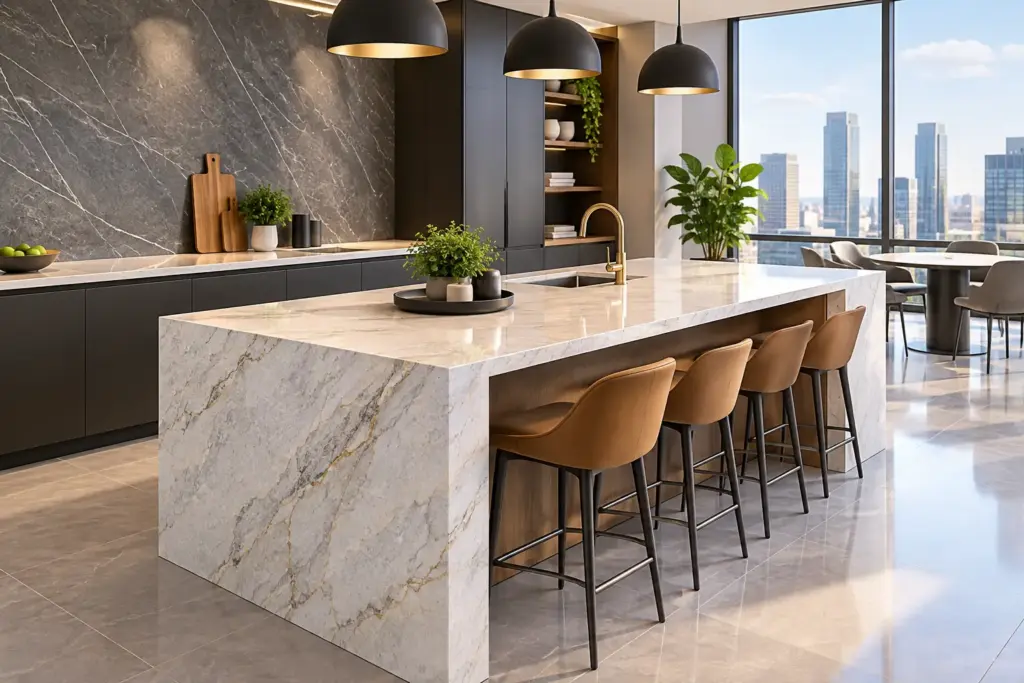
Workplace interiors present another balance. Kitchenettes, breakout areas, and meeting spaces need to feel elevated but durable. A well-selected engineered slab can unify joinery across several zones, helping a large floorplate feel coherent without becoming repetitive.
Detail Determines the Final Effect
The slab is only part of the result. Commercial stone surfaces are shaped by thickness, edge profile, joins, splashback height, lighting, substrate, and the skill of the fabrication team. A material that appears understated in a showroom may become highly expressive when wrapped down the side of an island or used as a full-height backdrop.
Consider the viewing distance. Fine veining can read beautifully at a vanity or meeting table, while stronger movement may be better appreciated on a large reception wall or feature counter. Where a project uses several stone elements, decide which one should lead. Repeating an assertive pattern everywhere can diminish its impact. Pairing a feature surface with quieter companion finishes usually creates a more resolved interior.
Lighting deserves equal attention. Warm lighting can draw out gold and cream tones in surfaces such as Santorini Gold or Royal Gold. Cooler light can sharpen white backgrounds and gray veining. Reviewing physical samples under the project’s proposed lighting conditions helps prevent surprises after installation.
Edges also communicate intent. A fine eased edge feels contemporary and restrained. A more substantial profile can give a counter gravitas, particularly in hospitality or luxury development settings. There is a practical trade-off: intricate profiles may increase fabrication complexity, cost, and lead time. The most convincing detail is often the one that supports the design without asking the material to become something it is not.
Specify Early, Inspect Carefully
Commercial schedules are unforgiving. Stone should be considered well before final fabrication measurements, not after cabinetry is underway. Early selection allows the project team to confirm slab availability, reserve material where necessary, review tonal consistency, and plan cuts around key veins or areas of movement.
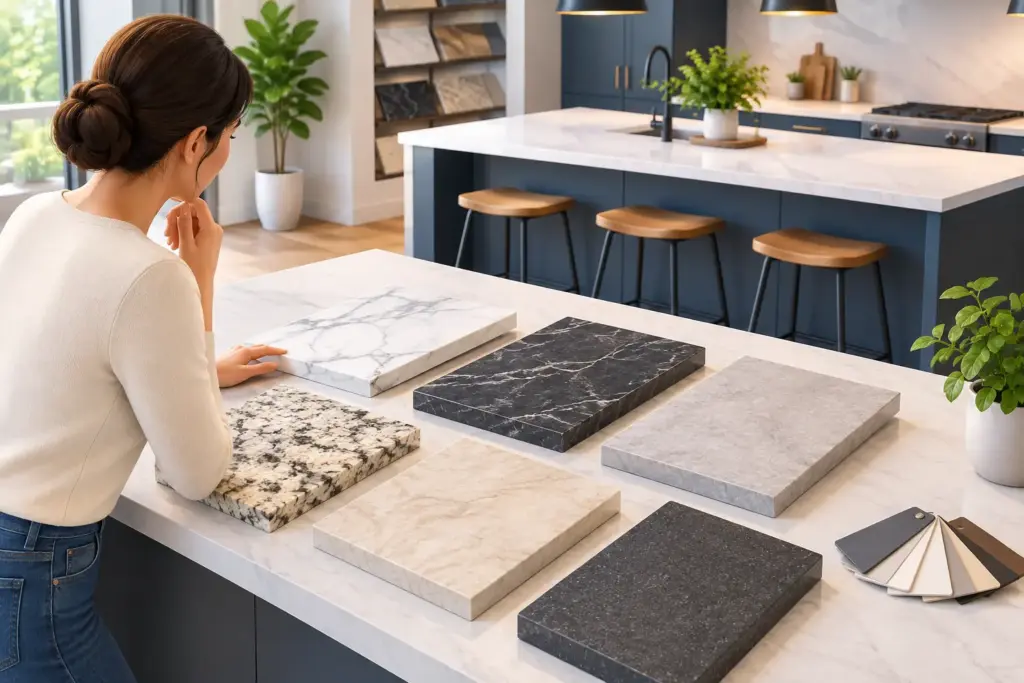
Physical slab inspection remains valuable even when a project begins with digital imagery and samples. Natural materials can vary from sample to slab, while engineered surfaces may show differences in pattern distribution and batch character. For a large reception desk or a sequence of bathroom vanities, inspecting the actual material provides clarity that a small swatch cannot.
Reliable supply matters as much as visual selection. A supplier with direct quarry relationships, slab-level quality control, and project-specific support can help reduce uncertainty when quantities, timing, and finish expectations are all under pressure. Avila Stones works with homeowners and trade teams to compare slabs, assess applications, and coordinate material choices for projects that need both design confidence and dependable delivery.
A Better Way to Build a Commercial Palette
Rather than treating stone as a final decorative layer, use it to establish the palette early. Start with the feeling the space should create: calm and gallery-like, warm and residential, crisp and corporate, or dark and theatrical. From there, assess which colors will be permanent, which finishes will age gracefully, and where the stone deserves visual prominence.
A pale, veined engineered surface can make a compact lobby feel brighter and more expansive. A deep charcoal or black surface can anchor a bar or executive suite. A naturally expressive slab can lend character to a single moment of arrival, allowing more economical finishes to perform quietly around it. This considered distribution of material often delivers more impact than using the same stone at every opportunity.
The best commercial specification is not simply the most dramatic slab in the showroom. It is the surface that feels right on opening day, remains practical through years of use, and gives everyone who enters the space a reason to pause and look closer.

Ready to Choose Your Stone?
Our team can walk you through every silica-free and natural option in the range.